 Swift code.
General Tips 
It is said that a review goes best when conducted on less than 400 lines of code at a time. You should do a proper and slow review, however, don’t spend on it more than 90 minutes  – you definitely will get tired after that time. It’s tiring to write and understand your own code and it’s even more tiring to understand someone’s. Other tips from the Internet are:
After some years of experience in software development you know what common programming mistakes are. You also do realise what solutions to common problems are most efficient. It’s a good practice to write it down and to check code being reviewed against a checklist ✅ – it leads improved results. Checklists are especially important for reviewers because, if the author forgets a task, the reviewer is likely to miss it too.
In the git flow mentioned in issue #13, code can get merged after receiving agreed number of approvals for a pull request. The number should depend on your team size, but it’s good to get at least 1️⃣ !
When you recommend fixes to the code, suggest their importance  . Maybe some of them could be postponed and extracted as separate tasks. Before approving a pull request, verify that defects are fixed
 .
.
Foster in your company a Good Code Review Culture in which finding defects is viewed positively . The point of software code review is to eliminate as many defects as possible, regardless of who "caused" the error. Few things feel better than getting praise from a peer. Reward developers for growth and effort. Offer as many positive comments as possible. I always try to put a line saying that a solution is good and clever (if it really is  ).
).
You can also benefit from The Ego Effect  . The Ego Effect drives developers to write better code because they know that others will be looking at their code and their metrics. No one wants to be known as the guy who makes all those junior-level mistakes. The Ego Effect drives developers to review their own work carefully before passing it on to others.
And don’t bother with code formatting style …
… there are much better things on which to spend your time, than arguing ☔️ over the placement of white spaces.
Looking for bugs and performance issues is the primary goal and is where the majority of your time should be spent.
So, what to review?
Much better things to look for should be a part of your checklist. When I scrutinise a piece of code I look especially:
- at
ifconditions,forandwhileloops for "off-by-one" errors - for interchanged
<versus<=and>versus>= for accidental interchange of && with || or bitwise operators like & and |UPDATED 11.06.2016 Swift compiler ensures that expression evaluated in a condition returns aBoolvalue, hence there’s no possibility not to catch compilation error if one interchanges operators- at operators importance and execution UPDATED 11.06.2016 If you happen a "million" of operators in one expression you’re probably doing something wrong by overcomplicating the solution… 😉
- if dependancy injection is possible (for the sake of unit testing).
- if variable names as verbose as needed
- if method names express what they do
- if a file contains commented out code
- if a file contains a single class (this one is arguable, depends on agreement with your team and company’s guidelines)
- for code duplication, function length and class length < x lines – SwiftLint or codebeat mentioned in issue #11 and issue #10 is an option to point out such a code without your participation
When performing a review, one can also get extra points for pointing out a more efficient implementation of used algorithm .
You should also check for readability. Is the code easy to understand? Do you have to pause frequently during the review to decipher it?
Some swifts
Boom! Time for some loosely coupled Swift code examples that I look for when reviewing Swift code❗️Wait a moment, this exclamation mark looks strangely familiar … ❗️Look out for code that uses it …
Swift

var foo: Object!

print("\(foo.someString)")
Make sure that your peers (and you as well) use the force unwrapping operator wisely in their code.
If you have ever ended up with code like the one below, then probably something went wrong … 

override init(_ objectId: String?,
viewModel1: ViewModel1,
viewModel2: ViewModel2,
viewModel3: ViewModel3,
viewModel4: ViewModel4,
viewModel5: ViewModel5,
viewModel6: ViewModel6,
viewModel7: ViewModel7,
viewModel8: ViewModel8,
viewModel9: ViewModel9,
viewModel10: ViewModel10,
isSomething: Bool = false) { ... }
This is an excerpt from from one of my projects, object types and names are changed . It’s an initialiser of a ‘container’ view model that encapsulates ‘child’ view models used by a container view controller. If you happen to achieve this and there’s no way to change it, probably usage of a configurator facade, default argument values or convenience initialisers are the best solution to live up with your legacy.
class Configurator {
    class func mainViewController() -> MainViewController {
        let dependency1 = Configurator.dependency1()
        let dependency2 = Configurator.dependency2()
        let dependency3 = Configurator.dependency3()
        let dependency4 = Configurator.dependency4()

        return MainViewController(dependency1: dependency1,
            dependency2: dependency2,
            dependency3: dependency3,
            dependency4: dependency4)
    }
}
The off-by-one errors and interchanged greater than & less than were my favourite mistakes at some point of time. I’ve caught myself a few times last year with using if i > array.count instead of if i < array.count ☔️.
Remember local autoreleasepool? For those who answered ‘what!?’ here is some explanation. I pay attention when reviewing body of a loop to check if local autoreleasepool could be used to reduce peak memory footprint.
for i in 1...100
autoreleasepool {
    NSString *superImportantString = "Super \(i)"
    //strange operations take place
    //superImportantString can be released earlier thanks to local autoreleasepool
}
More than a year ago, when Swift was still in its early days, I hated when my team members overused var. It’s ok when needed, but not all the time! Thanks god that now Swift compiler warns about not mutated var.
Another matter is your object’s properties. If it depends on some values, never ever use var. Use let. Always value more immutable state over var! I wonder how many people would argue with me about that☔️. And if your property really have to be mutable, expose it ‘to the public’ as immutable like that:
private(set) var foo: AnyObject
let bar: AnyObject
Swift’s protocols are a great deal – do you prefer composition over inheritance? Is such an inheritance chain ok for you? One superclass would be probably ok, but this becomes an exaggeration:
class ChildViewModel: TableViewModel {}
class TableViewModel: CRUDViewModel {}
class CRUDViewModel: BaseViewModel {}
class BaseViewModel {}
Final thoughts
Kofi Annan, Ghanaian ex-Secretary-General of the United Nations, when in primary school, was attending a weekly lesson in ‘spoken English’. He and his peers were asked by the teacher what did they see at the picture:

All shouted together, that they saw a black dot! Professor stepped back and said ‘So, not a single one saw the white sheet of paper. (…). This is the awful thing about human nature. People never see the goodness of things, and the broader picture. (…)’.
It’s also true for code review. We perceive better differences than loads of new code when using a merge tool. We get a cognitive overload if flooded with more content. Have that in mind and use the first rule – review for less than 90 minutes , take breaks. Remember that:
- new code is more difficult to understand
- not all bugs can be caught during a review
- hot fixes
 without review can happen …
And always – Review your own code first! Before committing a code look through all changes you have made!
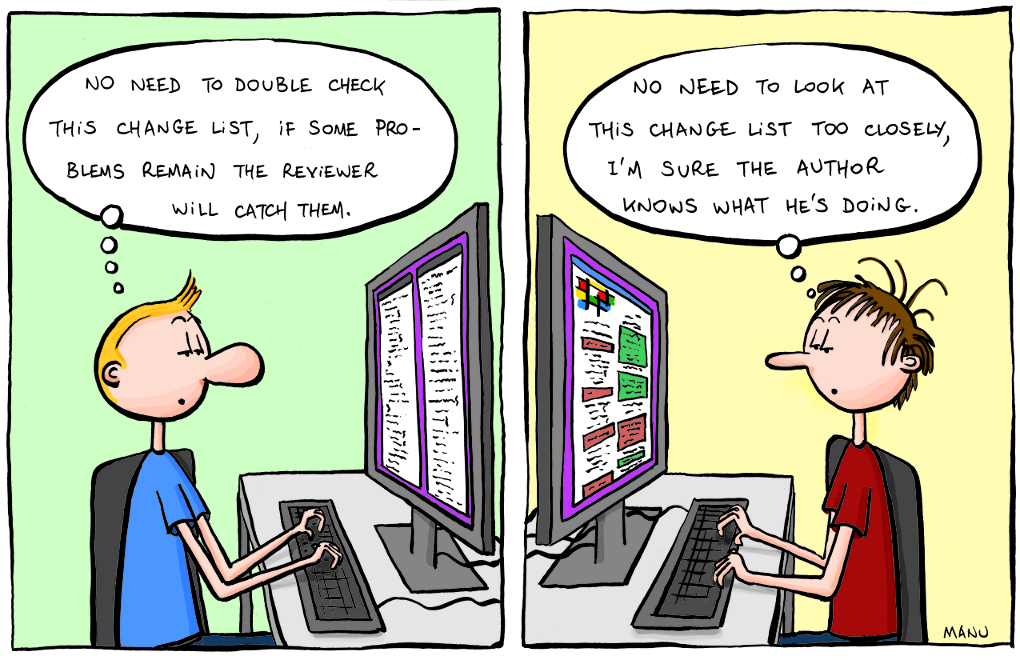
Let us know in comments or on Twitter what is on your checklists for code review!
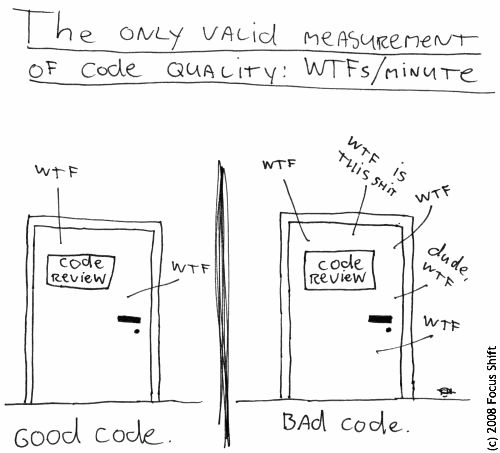
The only true measure of code quality
Additional links
]]>What is a code review?
The good old Wikipedia once wrote:
Code review is systematic examination (often known as peer review) of computer source code.

It is intended to find and fix mistakes overlooked in the initial development phase,

improving both the overall quality of software and the developers' skills.
Far enough. I want to do it! Wait, but …
How to do it?
Reviews can be done in various forms such as pair programming, informal walkthroughs, and formal inspections. The most known is probably this one – show me your code (aka informal review)! Simply ask your peer to have a look at your code.
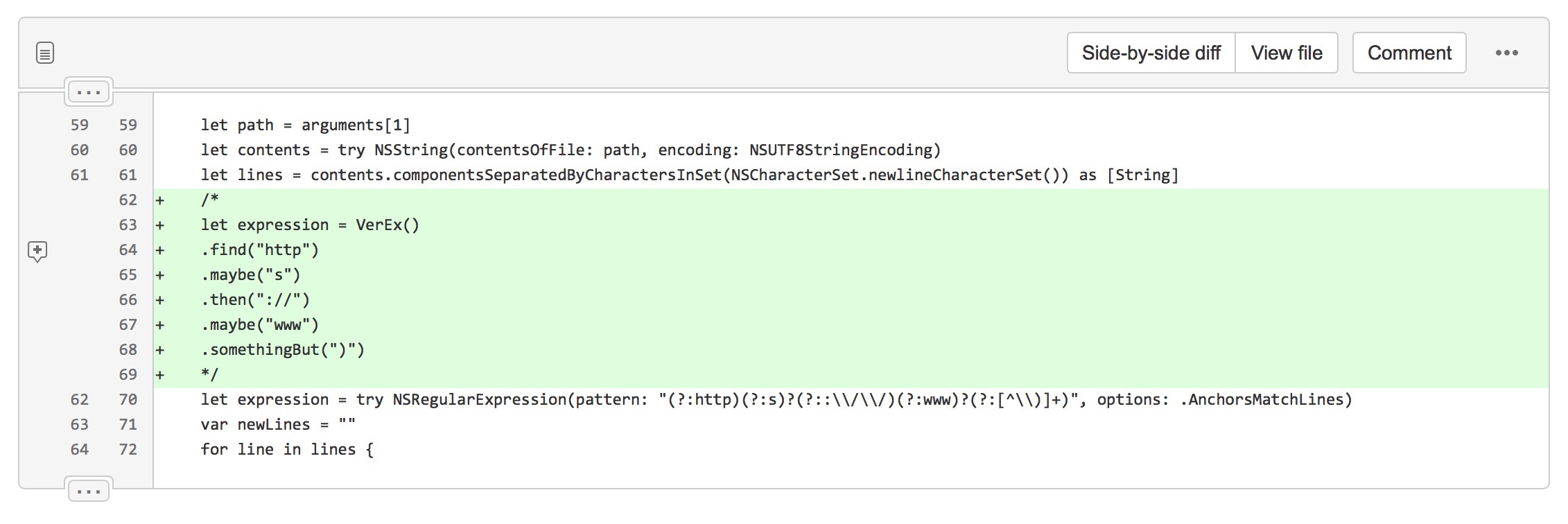
Formal code reviews can be performed by using e.g. Atlassian’s Crucible/Fisheye (I don’t like this tool, bad UX, hard to navigate and even start a review) or a pull request on Stash/BitBucket/GitHub or whatever you use. Thanks to those tools you get a nice visualisation of what changes were made to source code, you can comment on them, ask author some questions and they can explain their code in return. It’s like a conversation you would have in real life, but documented – what has been agreed should be performed before merging into develop. Wait, what merging?! We were just talking about a review …
Git flow
When developing different parts of an application at work we use Git and Git Flow to merge all changes into a parent branch. Once a feature of an app is finished we create a pull request that contains changes to be added to a predecessor branch (usually develop). The best picture showing the flow comes, in my opinion, from GitHub. I still don’t get what the squirrel on it represents… ⁉️
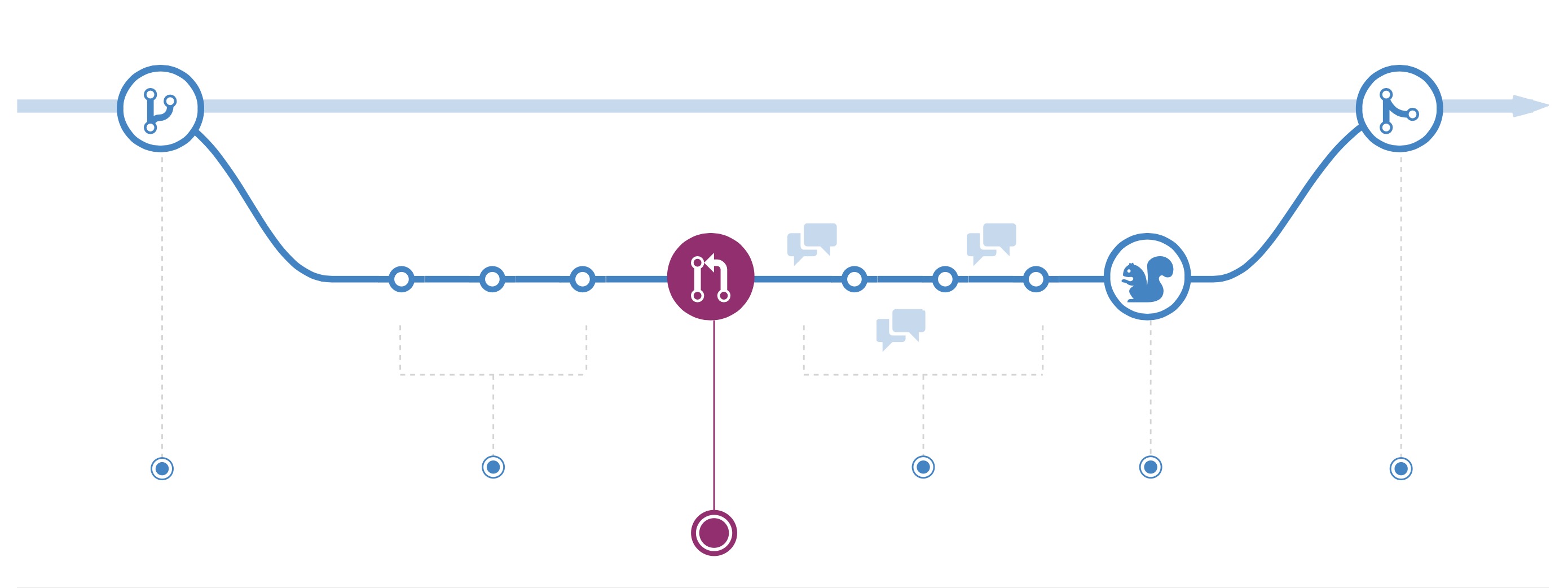
The flow goes like this:
- create a branch from e.g. develop
- apply your changes to the source code
- create a pull request to be merged into e.g. develop
- discuss changes with your peers, explain your point of view & apply suggested improvements
- a squirrel⁉️ approves your changes (or your peers, depends on the setup of your team and agreements, could be a squirrel in some cases … )
- merge your code into source branch
What to consider when doing a review?
You definitely should check code integrity – does the style match previous solutions, does it follow agreed conventions? Are features implemented correctly, does the old source code work correctly after changes?
Why to tap into code review in your development process?
For sure because it ensures code integrity , catches what others’ eyes didn’t see. It allows to learn and share your knowledge and expertise, strengthens communication in the team and builds good relationships due to conversations about what you have in common – code and programming skills ;)!
Unfortunately, from my experience, unit tests and code review are first things that get removed from project scope  . It takes too much time and there’s no budget for that. Do you encounter the same problems?
Consider code review as an investment into the future. If you don’t catch bugs now you will definitely have to conquer them in the future.
What if you didn’t perform code reviews
Imagine a company X. It delivers mobile app solutions for multiple clients. Their team is small and at some point they cannot meet clients’ demands. So they decide to outsource some of the work to an external company. They give project requirements to this company and meet again after 3 months to receive app source code. But the app is useless – it freezes at network calls, CoreData.ConcurrencyDebug flag crashes all the time. The project is delayed for a few months, team has to start from a scratch. The wish they had reviewed outsourced code on a daily basis…
How to start the process at your place?
Code review culture wasn’t common for mobile teams at my workplace. It still isn’t for some of the due to rapid development and short lifecycle of some of the mobile apps. However, I wanted to improve myself by learning from others. I’ve started with a prank. I’ve developed changes on a branch and have created a pull request for my colleagues. And it got the ball rolling. Now all mobile projects within my division embed code review in their development process.
Do you want to perform code reviews?
This is usually the question that gets lack of enthusiasm from the audience :(. But really, are we too busy to improve??
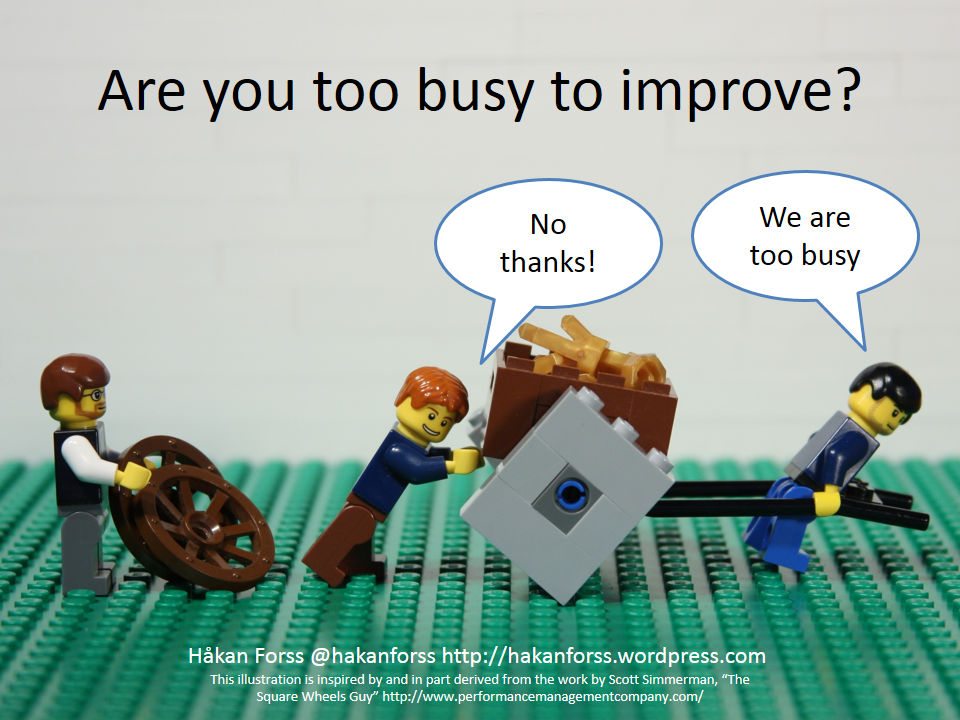
This was an introduction to code review. In the upcoming weeks we’ll get deeper into the process. Stay tuned  !
!